Saturday, January 26, 2008

South Carolina Results

Barack Obama has won the South Carolina Democratic primary with 55% of the vote (giving him 25 delegates) versus 27% for Hillary Clinton (12 delegates). John Edwards got the remaining 18% (8 delegates).

The exit polls reveal some interesting results. The most comprehensive numbers I've found online are at the MSNBC site.

The most dramatic demographic differences between the candidates are aligned, not surprisingly, along racial lines. Obama won 78% of the Black vote. Even just a couple of months ago, as you'll recall, he trailed Clinton in the polls among South Carolina Blacks and there was talk that he was viewed by them as an "American of African descent" but not an "African-American." Obviously, they've now fully embraced him.

Among Whites, however, Obama scored only 24%, in third place behind both Clinton and Edwards. The only exception to this was with young voters. He actually came in first with 52% among under-30 Whites. That age group, however, only comprised 11% of White voters.

After Iowa and New Hampshire, it became clear that Northern Whites will enthusiastically support Obama and vote for him in large numbers. Do the South Carolina results prove the conventional wisdom that Southern Whites will refuse to vote for any Black candidate?

Maybe that's the wrong question to ask. A more important question is whether the turnout of Southern White opposition in the general election would be larger against Obama than Clinton. Would bigots who can't stand the thought of a Black president be less upset at the prospect of a woman running the country?

The enthusiasm of such opposition would also depend, of course, on who the Republican nominee was. It's easy to imagine that McCain, Romney, or Giuliani might "inspire" rednecks to just stay home on election day. Huckabee, on the other hand, could conceivably mobilize the fundamentalist masses into a voting frenzy. But at the moment, it looks like Huckabee's star is waning.

Also remember that it's entirely possible to win the general election without winning a single Southern state. John Kerry lost every state in the South in 2004. But if he had won Ohio he would now be president.

One other bit of data in the South Carolina exit polls jumps out at me. The winner among White voters was John Edwards, with 40%. But among Blacks, he got an astonishingly tiny 2% of the votes. Is there something about Edwards that Black voters strongly dislike?

Friday, January 25, 2008

Outside the Frame

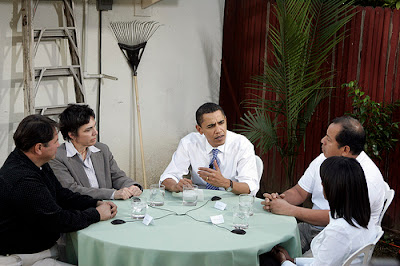
On January 16th, Barack Obama held a "roundtable discussion" in the back yard of Mimi Vitello of Van Nuys, California. The Obama Campaign released the following photo of the event:

Just five folks sitting around a patio table having a little chat. Small, casual, low-key, relaxed.

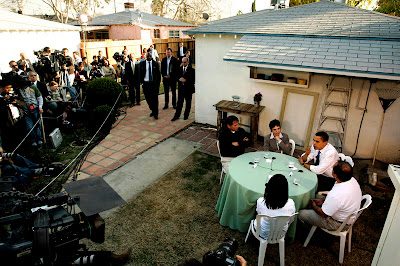
Don't believe everything you see.

Jonathan Alcorn was one of the photojournalists at the event. Here's a shot he took of the same scene, but using a wider angle:

Alcorn also publishes his work at jonathanalcorn.com and on Flickr.

Feingold Anti-Endorses Edwards

The Huffington Post recently published an interview with Senator Russ Feingold, one of the Democratic Party's most respected progressive leaders. He said he thought either Hillary Clinton or Barack Obama would be great presidents. But he's highly dubious of the sincerity of John Edwards. Feingold said:

I don't understand how somebody could vote, five or six critical votes, one way in the Senate and then make your campaign the opposite positions. That doesn't give me confidence that if the person became president that they would continue the kind of policies that they are using in the Democratic primary. I'm more likely to believe what they did in the Senate.

You have to consider what the audience is, and obviously these are very popular positions to take when you are in a primary where you are trying to get the progressive vote. But wait a minute — there were opportunities to vote against the bankruptcy bill, there was an opportunity to vote against the China [trade] deal. Those are the moments where you sort of find out where somebody is. So I think, people are being taken in a little bit that now he is taking these positions.

When asked which candidate he might endorse, Feingold replied:

There are all kinds of issues weighing on my mind. I'm trying to figure out who is most ready to be president in a very difficult world. I'm looking for somebody who can carry real change and a real feeling of unity in the country. I see some of these qualities in Senator Clinton and some in Senator Obama. And I simply don't feel that I am compelled to make a decision.

Clinton Endorsements

The New York Times has just published an editorial endorsing Hillary Clinton for president.

Here are a couple of paragraphs summarizing their reasoning:

On the major issues, there is no real gulf separating the two. They promise an end to the war in Iraq, more equitable taxation, more effective government spending, more concern for social issues, a restoration of civil liberties and an end to the politics of division of George W. Bush and Karl Rove.

The potential upside of a great Obama presidency is enticing, but this country faces huge problems, and will no doubt be facing more that we can’t foresee. The next president needs to start immediately on challenges that will require concrete solutions, resolve, and the ability to make government work. Mrs. Clinton is more qualified, right now, to be president.

They also offer Clinton some campaign advice; in particular, they ask her to stop the mud-slinging:

As strongly as we back her candidacy, we urge Mrs. Clinton to take the lead in changing the tone of the campaign. It is not good for the country, the Democratic Party or for Mrs. Clinton, who is often tagged as divisive, in part because of bitter feeling about her husband’s administration and the so-called permanent campaign. (Indeed, Bill Clinton’s overheated comments are feeding those resentments, and could do long-term damage to her candidacy if he continues this way.)

We know that she is capable of both uniting and leading. We saw her going town by town through New York in 2000, including places where Clinton-bashing was a popular sport. She won over skeptical voters and then delivered on her promises and handily won re-election in 2006. Mrs. Clinton must now do the same job with a broad range of America’s voters.

Followup (1/30/2008): The Los Angeles Times has published an essay by three of Robert Kennedy's children — Kathleen Kennedy Townsend, Robert F. Kennedy Jr. and Kerry Kennedy — endorsing Clinton. Some excerpts:

While talk of unity and compromise are inspiring to a nation wary of divisiveness, America stands at a historic crossroads where real issues divide our political landscapes. ... The loftiest poetry will not solve these issues. We need a president willing to engage in a fistfight to safeguard and restore our national virtues.

We have worked with Hillary Clinton for 15 years (and in Kathleen's case, 25 years) and witnessed the power and depth of her convictions firsthand. We've seen her formidable work ethic, courage in the face of adversity and her dignity and clear head in crisis. We've also seen her two-fisted willingness to enter the brawl when America's principles are challenged. Her measured rhetoric, political savvy and pragmatism shield the heart of our nation's most determined and most democratic warrior.

We need a leader who is battle-tested, resilient and sure-footed on the shifting landscapes of domestic and foreign policy. Hillary Clinton will move our country forward while promoting its noblest ideals.

Thursday, January 24, 2008

Hillary's 35 Years

NPR's All Things Considered broadcast a story today called "Tracing Hillary Clinton's '35 Years' of Experience".

Michele Norris interviewed Suzanne Goldenberg, author of Madam President, a recently-published book about Hillary Clinton. Norris and Goldenberg discuss what Hillary Clinton did in those years between Yale Law School in the early 1970's and her election as a U.S. Senator in 2000.

We've all heard Hillary tout her "35 years of fighting for change." If she were scrupulously honest, she might rephrase it as "35 years fighting off and on for change, including a few years in which I was a corporate lawyer representing clients with not-so-progressive policies." The additional verbiage would be a fairly objective description of her work with the Rose Law Firm from 1977 to 1992.

Then again, that would be quite a mouthful. And to a politician, oversimplifying things comes second only to portraying oneself in a positive light.

Does Hillary Clinton sometimes distort the truth? Yes, of course; she's a successful politician. Is Hillary a pathological liar? No, she's just a successful politician. Is she the devil incarnate? Don't be ridiculous.

Is George W. Bush the devil incarnate? No, he's just the guy who buys cigarettes for the devil. How about Dick Cheney? Hmm... possibly.

But I digress.

Back to Hillary's portrayal of her record. Goldenberg sums it up as follows:

It's hard to see how her claim adds up. But you have to remember that every candidate on the campaign trail is going to embellish their record. John Edwards, for example, is 54 years old and we hear him talking about 54 years working for the little people and for poor people. This is what politicians do. They play up the good parts of their resume and play down the bits they'd rather people forgot about.

I suppose it's conceivable, by a very strict adherence to the semantics of the English language, that someone who is two years old could be "working for the little people." On the other hand, it's also conceivable that such a claim is motivated by something less innocent than just "playing up the good parts."

I'm inclined to argue that Barack Obama has engaged in considerably less of this kind of "embellishment." And, furthermore, that the quantity of his relevant "experience" may actually approach that of Hillary.

But don't get me started. That's a whole other blog post.


Tuesday, January 22, 2008

Hillary vs Obama

Who needs TV when there's LisaNova (aka Lisa Donovan) on YouTube?

This video, featuring her and Jordan Peele, was posted back in May, but it's becoming more and more relevant with each passing day.

(Click below to play video)

Verbal Pugilism

From Monday night's Democratic debate:

Obama: "While I was working on those streets, watching those folks see their jobs shift overseas, you were a corporate lawyer sitting on the board of Wal-Mart."
...
Clinton: "I was fighting against those [Republican] ideas when you were practicing law and representing your contributor, Rezko, in his slum landlord business in inner-city Chicago."
...
Edwards: "Are there three people in this debate, not two?"

(Click below to play video)

Videos of the full debate can be downloaded from CNN.

There's a good analysis of the candidates' claims at factcheck.org.

Tuesday, January 15, 2008

Pot Brownies 911 Call

Another in the Oldies But Goodies category...

(Click below to play video)

The caller is Edward Sanchez, an officer in the Detroit Police Department. According to Wikipedia, he initially tried to pin all the blame on his wife, but later confessed that he had stolen the marijuana from the police evidence room. He resigned from the police department, whereupon all charges against him were dropped.

(Should the charges have been dropped? Did the DA give Sanchez preferential treatment because he was a cop? Would they have dropped the charges against you or me? Or would we now be serving a multiyear prison sentence? Don't get me started.)

When the time comes, please inscribe the following on my tombstone:

I think I'm dead, I really do.
Time is going by really, really, really, really slow.

Monday, January 14, 2008

What Song Is This?

Just for the record, I guessed correctly.

No, really. Honest...

(Click below to play video)

Terminate the Terminator?

In 2003, Arnold Schwarzenegger became Governor of California in a recall election precipitated by the state's $16.5 billion budget deficit. Under Schwarzenegger's governorship, the state has lowered taxes while raising spending. Until recently, this policy seemed viable, largely due to California's real estate bubble.

But, in case you haven't heard, that bubble has burst. Big time. We now live in the post-subprime era.

The result? California's economy is being pummeled and state government revenues are drying up faster than the lips of a Hollywood starlet driving a convertible down I-5. Governor Schwarzenegger recently declared a "fiscal emergency" due to the projected $14.5 billion shortfall in the 2008 budget.

Schwarzenegger's proposed solutions to the crisis have been predictable. Predictable, that is, if you remember that he's what used to be called a Rockefeller Republican: socially moderate but fiscally very conservative. Unfortunately, most Californians only seem to care about the socially moderate part.

Schwarzenegger is demanding three things from state legislators:
1. increase the state's bond debt by an additional $3.3 billion;
2. cut government programs across the board by 10%;
3. amend the state's constitution so that future cuts will occur automatically.

He's also proposing that we play some accounting tricks to include projected revenues from future years into this year's budget.

But he adamantly insists there cannot, under any circumstances, be any tax increases. Not even for the wealthy. Especially not for the wealthy.

The results of the proposed budget cuts would be staggering. K-12 education would be cut, college education would be cut, Medi-Cal funding would be cut, dozens of state parks would be closed, 22,000 prisoners would be released, the list goes on and on. Poor people would be especially hard hit by the cutbacks.

Can you imagine if Gray Davis had made such proposals to solve the 2003 budget crisis? The streets of Sacramento would have been filled with protesters. Davis would have been dragged away by an angry lynch mob.

Californians, is it time for another recall election? Where is the outrage that was so evident in 2003? Where are the grassroots petitions to rid ourselves of incompetence?

Or, in fact, did the demise of Gray Davis in 2003 have nothing to do with grassroots outrage?

Wednesday, January 9, 2008

What's the Diff?

What are the differences between Hillary Clinton and Barack Obama? Is choosing one over the other just a question of whose style you like? Is it nothing more than whether you prefer Change, or whether you prefer Experience?

Can you tell me anything about how they differ on substantive issues?

If all your news coverage comes from the soundbite-driven mainstream press, then you might be forgiven for thinking that there really aren't any substantive differences between the two candidates, that this whole political process we're currently engaged in is nothing more than a sporting event. The news is great at reporting every detail of who's up, who's down, whether Hillary got teary-eyed, or whether Barack got a little snarky. But when it comes to issues, the major news outlets haven't told us very much, have they?

If you're a bit of a political junky, you might have heard that the two candidates differ slightly in their plans for universal health care. Clinton's proposal would be mandatory for everyone, while Obama's would be incentive-driven and mandatory only for children.

Okay, that's a start. Can you tell me anything else about their health care plans? And what about other issues? How will they improve our education system? What do they say about alternative energy and energy independence? What will their economic policies be? What are their plans for fixing Iraq? How about globalization and trade? Terrorism? Immigration?

If you're like me, you're probably drawing a blank on most of these questions. But in four weeks, assuming you're a registered Democrat in one of the "Super-Duper Tuesday" states, you'll be asked to vote for one of the candidates. What criteria will you use to make a choice? Will you decide merely on the basis of Change versus Experience? Or are you more of a Teary-Eyed versus Snarky kind of person? (If your answer to these questions is, "I'm voting for Edwards," then fine, tell me some substantive details about his policies.)

David Leonhardt writes a column on economics for the New York Times. He recently published an article describing the differences in economic philosophies between Clinton and Obama.

I highly encourage you to read the entire article but here are some excerpts to whet your appetite:

Compared with all the other candidates — Democrat and Republican — Mrs. Clinton and Mr. Obama occupy roughly the same place on the ideological spectrum. They’re both somewhat to the right of John Edwards, who favors a more muscular brand of government intervention to help the middle class. And they are well to the left of every Republican.

The easiest way to describe Senator Clinton’s philosophy is to say that she believes in the promise of narrowly tailored government policies, like focused tax cuts. She has more faith that government can do what it sets out to do, which is a traditionally liberal view. Yet she also subscribes to the conservative idea that people respond rationally to financial incentives.

Senator Obama’s ideas, on the other hand, draw heavily on behavioral economics, a left-leaning academic movement that has challenged traditional neoclassical economics over the last few decades. Behavioral economists consider an abiding faith in rationality to be wishful thinking. To Mr. Obama, a simpler program — one less likely to confuse people — is often a smarter program.

Leonhardt's article will give you a good start on the differences in economic policies. Good luck researching all the other issues. You have four weeks to become an informed voter.

Followup (1/16/2008): Here are some more resources:
1. Wikipedia has pages overviewing the political positions of Clinton and Obama.
2. ontheissues.org has lists of quotes and voting records for Clinton and Obama.
3. CNNpolitics.com has brief position summaries for all the candidates.
4. National Journal has rankings of senators' voting records.
5. Project Vote Smart has interest group ratings for Clinton and Obama.
6. The Washington Post has voting databases for Clinton and Obama.
7. The Washington Post, Slate, and The Kaiser Foundation have compared their health care plans.
8. RealNews Network has a video comparing their health care plans.

Followup (1/24/2008): After exhaustively analyzing everything I can find online, I've concluded that there just aren't that many substantive policy differences between the two candidates. So I've decided to base my vote on shallow considerations like style, charisma, and personality. I haven't figured out yet whether I prefer Change, or whether I prefer Experience. But when February 5th arrives, I'm going to vote for whichever candidate is taller, better tanned, and has a more attractive spouse.

Tuesday, January 8, 2008

Voters Want Change

McCain and Clinton have just won the New Hampshire primaries — Obama is delivering his concession speech even as I type this.

The bodies of the losers are still warm but the pundits already have a nice, tidy explanation for the somewhat surprising results: In Iowa, voters chose the candidates who most advocated Change; in New Hampshire, they've chosen the candidates they believe are most capable of delivering it.

(I'm a little baffled why anyone thinks McCain represents Change. But, hey, I'm not a pundit, so what do I know? Never mind that these are the same pundits who delivered eulogies yesterday for the Clinton campaign.)

In the debates on Saturday, the most overused buzzword was Change. For the past few days, the rhetoric from all the candidates has been Change This, Change That, Change, Change, Change. To paraphrase Joe Biden, every sentence they speak now has a noun, a verb, and Change.

Not even Romney could resist jumping on the bandwagon. In a speech yesterday, he said, "I've brought Change to every organization I've been involved with. That message, by the way, of bringing real Change, is sweeping the country." This from the man who frequently criticizes his Republican opponents for being too lukewarm in their support of President Bush.

So, apparently, all of the candidates' overpaid consultants are unanimous in their opinions of what we, the People, want. Change.

Is Change what you want? If so, I'd like to suggest someone who can deliver it far more capably than any of the candidates currently in the race. Someone who has far more experience than any of them.

When it comes to Change, there is one unparalleled world authority....

(Click below to play video)

Free Lunch

In a recent broadcast of Fresh Air, Terry Gross interviewed Pulitzer Prize winning investigative reporter David Cay Johnston about his new book, Free Lunch, which details cases of corporate socialism masquerading as free market economics.

In the interview, Johnston says:

Ronald Reagan... set in motion a vast new experiment in whether reducing the size of government, reducing government regulation, and relying on market solutions would make us wealthier, happier, healthier, and a better country. A generation of time has now passed.... Are you better off than you were a generation ago?

On the surface, we are. We're twice as wealthy as we were then, as a country. But when you look deeper, you find out that no, most of us are worse off.

Incomes for most Americans have stagnated. But for those at the top they've gone through the roof. Growing numbers of people don't have health insurance. Fewer and fewer people have pension plans. More and more people are filing bankruptcy and are in debt.

How did this happen?

In his book, Johnston offers the following explanation of how it happened:

Since the Reagan administration, it's become the unstated policy to create federal laws and regulations that favor the already wealthy and the politically connected.

Money for the basics that make society work — from raking leaves in the park, to highway bridge maintenance — is dwindling, because so much has been diverted to the already rich, through giveaways, tax breaks, and a host of subsidies that range from the explicit to the deeply hidden.

Followup (1/18/2008): David Cay Johnston was interviewed by Bill Moyers.

Friday, January 4, 2008

Michael Moore vs. Wolf Blitzer

I know several people who've just watched Michael Moore's movie Sicko for the first time, so I thought I'd post this even though it happened several months ago.

On July 9, 2007, the CNN show Situation Room, hosted by Wolf Blitzer, did a segment on Sicko.

It began with a 4-minute piece criticizing the movie, or as Blitzer put it: "a reality check from our chief medical correspondent, Dr. Sanjay Gupta."

(Click below to play video)

Moore then gave his response, which, as you'll see, was quite "spirited."

(Click below to play video)

Even though Moore was extremely critical of Blitzer and CNN, to their credit they taped an additional segment, which was broadcast the following day.

(Click below to play video)

Finally, here's some editorial commentary on the whole thing by my favorite kneejerk progressive journalist, Keith Olbermann.

(Click below to play video)

Iowa Results

Three things stand out in my mind about last night's Iowa caucus results.

1. White voters are excited about Obama. More than 93% of Iowans are White, at least 50% call themselves Born Again Christians, and the split between Republicans and Democrats is roughly 50-50. In spite of all this, Barack Obama got more votes last night than Huckabee and Romney combined. This gives me hope that maybe our country's racism has subsided enough to elect a Black man.

2. Romney and Clinton failed miserably. Both candidates mounted full-scale campaigns and spent big bucks in Iowa. Both finished nine points behind the leaders. Ouch. For both of them, it's now imperative that they win convincingly in New Hampshire. I predict neither of them will.

3. Obama's victory speech. Even seasoned, jaded political pundits are talking about how inspiring it was. Some have even said it was evocative of Martin Luther King and Bobby Kennedy.

(Click below to play video)

Favorite quote:

There are days of disappointment. But sometimes, just sometimes, there are nights like this. A night that years from now — when we've made the changes that we believe in, when more families can afford to see a doctor, when our children inherit a planet that's a little cleaner and safer, when the world sees America differently and America sees itself as a nation less divided and more united — you'll be able to look back with pride and say that this was the moment when it all began.

This was the moment when we tore down barriers that have divided us for too long, when we rallied people from all parties and ages to a common cause, when we finally gave Americans who had never participated in politics a reason to stand up. This was the moment when we finally beat back the politics of fear and doubt and cynicism, the politics where we tear each other down instead of lifting this country up. This was the moment.

Followup (1/5/2008): One of the quirks of the Iowa caucus is that the number of Republican votes is tallied normally, while the number of Democratic votes is only estimated. According to Reuters, Democratic turnout was approximately 239,000. Plugging this value into the results reported by CNN reveals that Obama probably outscored the top three Republican candidates combined (Huckabee, Romney, and Thompson).

Wednesday, January 2, 2008

Dream Theory

With rare exceptions, everyone dreams periodically while they sleep. And it's not just humans; based on REM activity and other evidence, it appears that almost all species of mammals also dream. Why? What purpose do these sometimes crazy hallucinations serve?

More to the point, why did dreaming evolve in our distant mammalian ancestors? What adaptive advantage did a tree shrew who dreamt have over its otherwise identical relatives who didn't? How could a propensity to hallucinate possibly confer an advantage?

Over the years, countless hypotheses have been proposed to explain the mystery of dreaming. Freud believed that dreams serve as a window into the subconscious mind. The trend among many modern researchers, on the other hand, is to see dreaming as merely epiphenomenal, an accidental byproduct of activity in the mammalian cortex, serving no real useful function. But there's still no consensus among researchers. And, until recently, none of the proposed explanations could account for all the known experimental data.

Psychology Today recently posted an article describing a promising new hypothesis by Finnish psychologist Antti Revonsuo. He proposes that dreams are a "training ground" in which sleeping animals rehearse behaviors that are vital to their survival. From the article:

Revonsuo believes that dreams are a sort of nighttime theater in which our brains screen realistic scenarios. This virtual reality simulates emergency situations and provides an arena for safe training. As Revonsuo puts it, "The primary function of negative dreams is rehearsal for similar real events, so that threat recognition and avoidance happens faster and more automatically in comparable real situations."

In hindsight, Revonsuo's explanation is not only plausible but trivially obvious. Therefore, it must be true. I hereby declare it a fact. :-)

Monday, December 31, 2007

Huckabee Hypocrisy

Today Mike Huckabee held a press conference in which he congratulated himself for deciding not to run an anti-Romney attack ad. Here was his explanation:

At some point we have to decide, can we change the kind of politics and the level of discourse? I'd like to believe we can, and it's got to start somewhere, and it might as well start here, and it might as well start with me.

He then proceeded to show the ad to the assembled reporters and gave them all a transcript of its contents.

Huh? Did I miss something?

Oh I get it... By claiming to not realize that he'd deliberately failed to not run a negative ad, he "change[d] the kind of politics and the level of discourse."

Very clever, Mike!

(Click below to play video)

Sunday, December 30, 2007

Bhutto Assassination Coverup

Britain's Channel 4 News is reporting what it calls "the most conclusive evidence yet that Benazir Bhutto was shot, contradicting the government's official version of events..."

(Click below to play video)

Pakistan's Interior Ministry initially said Bhutto died of gunshot wounds to the neck. Then they said that shrapnel from the bomb blast killed her. Now they're saying that she "fell down or perhaps ducked" when she heard gunfire and hit her head on a lever attached to the car's sunroof. According to Javed Iqbal Cheema, a spokesman for the Interior Ministry, her death "did not result from a bullet or shrapnel and nothing entered her head."

Many eyewitnesses and forensic experts say this latest explanation is preposterous. But if the Pakistani government is lying, what is their motive? What would they gain by it?

One possibility has been suggested by Ken Robinson, a former US Intelligence officer in Pakistan who now provides analysis for CNN. CNN recently posted a story saying that

[Robinson] suspects Bhutto's enemies are attempting to control her legacy by minimizing the attack's role in her demise. "They're trying to deny her a martyr's death, and in Islam, that's pretty important," Robinson said. Bhutto, he said, threatens to become more influential in death than she was in life.... Only if Bhutto's family allows an autopsy, said Robinson, will the world know for certain the medical reasons behind her death.

Bhutto was buried on Friday. So far, her husband has refused to permit an autopsy.

Followup (1/1/2008): The Pakistani government is now backing away from their claims that Bhutto was killed by hitting the sunroof lever, according to reports by The Chicago Tribune and The Times of India.

Followup (1/2/2008): Today the Pakistani government once again made a reversal in its official explanation. To be precise, this is a reversal of a reversal of a reversal of a... Oh, never mind, I've lost count.

Pakistani newspapers are now carrying the following:

The Ministry of Interior has clarified that a news item has appeared in some papers today regarding an apology tendered by the caretaker minister for interior for certain remarks of the spokesman while briefing the press about the possible cause of the tragic death of Mohtarma Benazir Bhutto. A press release clarified that the minister did not apologise for any such remarks. As a matter of fact he had merely appealed to the editors to overlook the tone and style of the spokesman which may not have been received well.

Okay, whatever. Just do an autopsy already.

Thursday, December 27, 2007

Cheney's Law

I finally got around to watching Michael Kirk's excellent documentary, Cheney's Law, which was broadcast as an episode of Frontline back in October.

The program details how Dick Cheney spent 25 years arguing that presidential power should be increased and then quickly seized the opportunity to do exactly that in the aftermath of 9/11. Cheney and his lawyer David Addington orchestrated several controversial legal decisions by the White House and Justice Department. The net result was greatly expanded executive power, granting George Bush the right to detain, interrogate, torture, wiretap, and spy — all without any need for congressional approval or judicial review.

(Click below to play video)

Friday, December 21, 2007

Another Bubble v1.1

The video that's been called the theme song of Silicon Valley, Here Comes Another Bubble, was unavailable online for a couple of weeks due to legal threats. Photographer Lane Hartwell sent take-down notices to YouTube and other venues, citing that the video made unauthorized use of one of her photographs.

The Richter Scales have now issued a new version of the video with Hartwell's intellectual property removed. Enjoy...

(Click below to play video)

Below is the controversial photo that was removed from the video, used here without permission.
Woohoo! I'm a lawless rebel! What a rush!

Followup (12/22/2007): At least one more photographer has objected to the use of their work in the video. So it looks like there will be a version 1.2.